
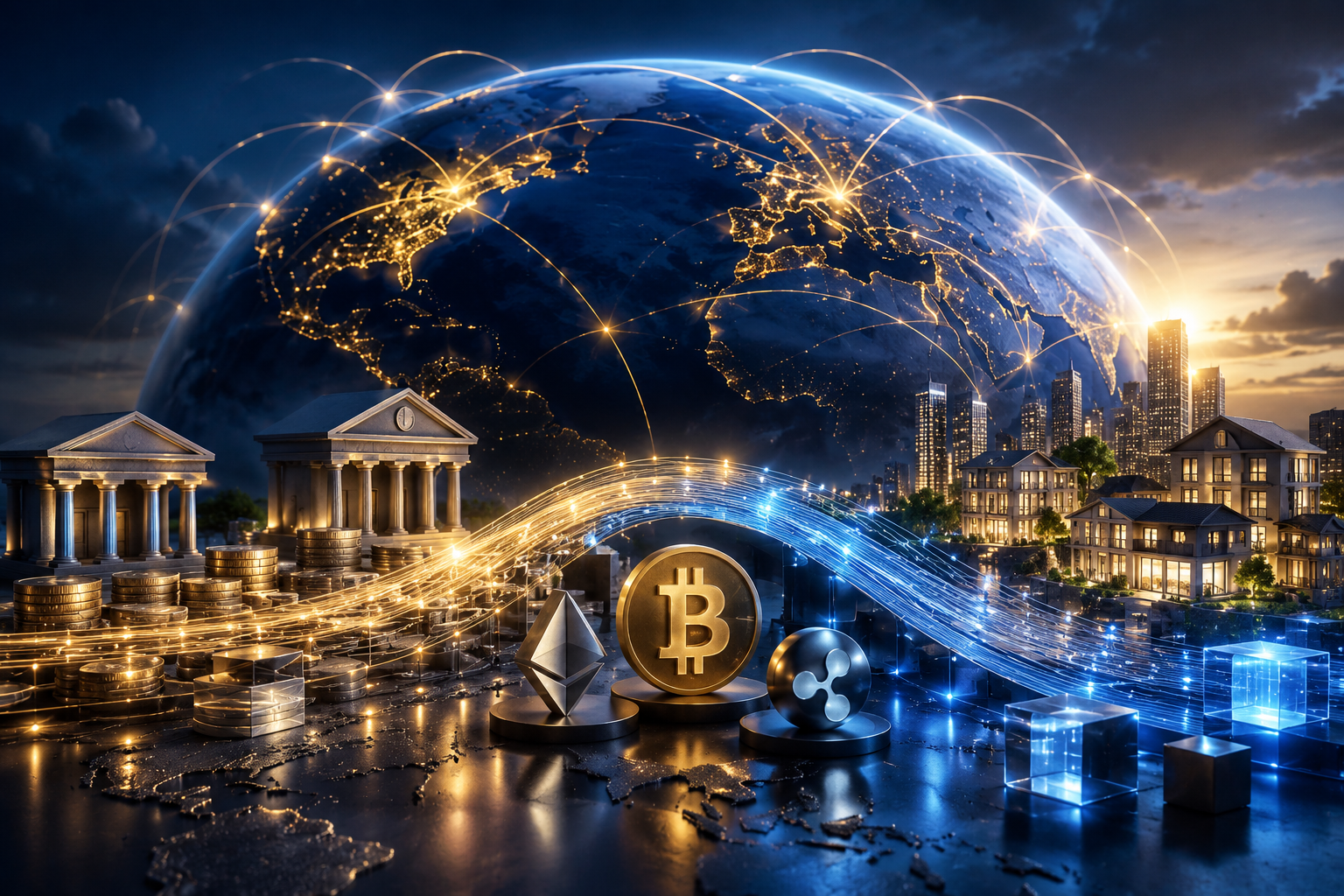
If you spend enough time online, it can feel like the digital asset market is already overcrowded.
Thousands of tokens exist. Bitcoin is globally recognized. Stablecoins move hundreds of billions of dollars. Major financial institutions have entered the market. Exchanges operate around the world.
So it raises an important question:
Are digital assets becoming saturated?
I don’t think that’s the right way to look at it.
Certain speculative corners of the market may absolutely be overcrowded. But the much larger transformation—the movement of global money and financial assets onto digital settlement infrastructure—is still in its early stages.
And understanding why starts with understanding market saturation.
What Is Market Saturation?
A market becomes saturated when most economically viable demand has already been captured.
Imagine 100 potential customers.
If only 10 use a particular technology, there is enormous room for adoption.
If 50 use it, the market is developing.
If 95 already use it, companies increasingly have to compete for existing customers rather than capture entirely new demand.
That’s saturation.
The mistake is looking at the number of cryptocurrencies and concluding that digital finance itself must therefore be saturated.
Those are two completely different things.
There may already be too many speculative tokens competing for attention.
But how much of the world’s banking, foreign exchange, securities, credit, real estate and institutional capital actually operates on programmable digital settlement rails?
Relatively little.
That’s where the opportunity becomes interesting.
Follow the Liquidity
To understand the scale, look at foreign exchange.
The FX market handles trillions of dollars every day as governments, banks, corporations, investors and institutions exchange one currency for another.
This isn’t primarily speculation.
A Swiss institution investing in America may need CHF converted into USD.
An American company purchasing equipment from Japan may need dollars converted into yen.
A European investor acquiring an American asset may need euros converted into dollars.
Global commerce requires global liquidity.
And historically, moving that liquidity has depended upon a massive network of:
Banks
Correspondent banking relationships
FX dealers
Clearing systems
Settlement systems
Custodians
Market makers
And pre-funded accounts.
Digital assets introduce an entirely new possibility:
What if different pools of global liquidity could become interoperable through programmable financial networks?
That is a much bigger idea than simply buying cryptocurrency.
Stablecoins Were One of the First Bridges
Stablecoins demonstrated something extremely important.
A dollar-like instrument could exist on blockchain infrastructure.
Instead of money being restricted entirely to traditional banking hours and banking networks, stablecoins could move across digital networks around the clock.
Suddenly:
Dollar value became programmable.
A user could move money from a bank account to an exchange, convert dollars into a stablecoin such as USDC or USDT, and transfer that value through blockchain infrastructure.
The process looks roughly like this:
Bank account
↓
Digital asset exchange
↓
USD → Stablecoin
↓
Blockchain
↓
Recipient
That was a major breakthrough.
But there’s an important limitation.
The dollars sitting inside the bank didn’t actually become blockchain-native.
They were converted into another financial instrument capable of operating on blockchain rails.
That distinction leads directly to tokenized deposits.
What Are Tokenized Deposits?
Tokenized deposits sound complicated.
The underlying concept is actually simple.
Imagine you have:
$1 million deposited at a bank.
Traditionally, the bank’s internal ledger records that it owes your account $1 million.
A tokenized deposit essentially creates a programmable digital representation of that commercial-bank deposit.
The critical difference is that the money remains a liability of the bank.
Compare:
Traditional bank deposit
$1 million recorded on the bank’s ledger.
Stablecoin
A digital dollar-like instrument issued by a stablecoin issuer.
Tokenized bank deposit
A bank deposit represented on programmable digital infrastructure.
This means banks potentially don’t have to move enormous amounts of money outside the commercial banking system simply to take advantage of digital settlement technology.
Instead, they can potentially make bank money itself programmable.
Why Would We Need This If Exchanges Already Work?
This is the obvious question.
Today, an individual can connect a bank account to a digital asset exchange.
From there:
USD → XRP
USD → USDC
USD → USDT
USD → Bitcoin
So why bother tokenizing deposits?
Because what works perfectly well for an individual investor isn’t necessarily the ideal architecture for institutions moving hundreds of millions—or billions—of dollars.
Imagine two global banks settling a $500 million foreign-exchange transaction.
One approach could require:
Bank deposit → exchange/custodian → digital asset → settlement network → conversion → receiving bank
That can work.
But the banks may prefer to keep their liquidity inside regulated commercial-bank money.
Tokenized deposits potentially allow:
Tokenized Bank A deposit
↓
Digital liquidity and settlement infrastructure
↓
Tokenized Bank B deposit
The banking system doesn’t necessarily disappear.
Its money becomes programmable.
That is a fundamentally different transition.
Now Add Digital Liquidity
This is where assets such as XRP become particularly interesting.
Suppose there is enormous liquidity between USD and EUR.
A direct exchange may already be extremely efficient.
There may be little reason to introduce another asset.
But consider a less-liquid currency corridor.
Instead of maintaining pools of every possible currency pair, a highly liquid digital asset could potentially act as a temporary bridge.
Conceptually:
Currency A
↓
XRP
↓
Currency B
XRP doesn’t necessarily need to become the currency everyone saves in.
It doesn’t necessarily need to replace dollars, euros or yen.
Its potential economic role is much narrower:
Bridge fragmented pools of liquidity when doing so is more efficient than the alternatives.
And importantly, XRP doesn’t have to win every transaction.
A future liquidity system could evaluate multiple routes:
Direct FX
Stablecoin → Stablecoin
Tokenized deposit → Tokenized deposit
Currency → XRP → Currency
Traditional banking rails
Then automatically select the cheapest, safest, most liquid and compliant route.
That is much more powerful than forcing every transaction through one blockchain or digital asset.
The Future May Be a Liquidity Router
This is where the pieces begin fitting together.
Imagine a global financial network containing:
Commercial bank deposits
Tokenized bank deposits
Stablecoins
Central-bank money
Bitcoin
XRP and other digital assets
Traditional FX markets
Digital exchanges
Institutional market makers
Instead of replacing all of these systems with one winner, software could connect them.
Someone needs $100 million converted from Currency A into Currency B.
The system asks:
Which route provides the best execution right now?
It evaluates:
Liquidity
Exchange rates
Spreads
Transaction costs
Counterparty exposure
Settlement time
Regulatory requirements
Finality
Then it routes the transaction accordingly.
The user doesn’t necessarily even know what happened underneath.
Think about the internet.
When you send information across the world, you don’t select every server, fiber-optic cable and network through which your data travels.
The network routes the information.
Financial infrastructure could increasingly work the same way.
Tokenized Deposits Could Unlock Existing Liquidity
This is perhaps the most important realization.
The objective doesn’t necessarily need to be:
Move all global money into digital assets.
Instead:
Make existing global liquidity interoperable with digital financial networks.
That’s much more achievable.
Banks don’t necessarily have to disappear.
Fiat currencies don’t have to disappear.
Traditional FX doesn’t have to disappear.
Stablecoins don’t have to replace bank deposits.
XRP doesn’t have to replace the dollar.
Bitcoin doesn’t have to become transactional money for every purchase.
Each technology can perform the function for which it is best suited.
Tokenized deposits can bring commercial-bank liquidity onto programmable infrastructure.
Stablecoins can provide highly portable digital cash-like instruments.
Digital assets such as XRP can potentially bridge fragmented liquidity.
Bitcoin can serve a different function as a scarce global monetary asset and potential collateral.
And smart-contract networks can coordinate settlement between them.
From Moving Money to Moving Ownership
Then comes the next evolution.
Once money becomes programmable, ownership can become programmable too.
Consider buying a financial asset today.
Money moves through one infrastructure.
Ownership records move through another.
Clearing happens somewhere else.
Custody happens somewhere else.
Reconciliation occurs between institutions.
Tokenization creates the possibility of bringing those processes closer together.
Imagine:
Digital money
↓
Atomic settlement
↓
Digital ownership
The money doesn’t move unless ownership moves.
Ownership doesn’t move unless the money moves.
In foreign exchange, the corresponding concept is payment-versus-payment.
In securities and asset markets, it is delivery-versus-payment.
That could eventually connect global liquidity directly to:
Real estate
Bonds
Private credit
Equities
Infrastructure
Commodities
Energy
Businesses
And other productive assets.
Now we’re no longer talking about “crypto.”
We’re talking about financial infrastructure.
So Are Digital Assets Saturated?
Certain parts are.
There are more than enough speculative tokens.
There are more than enough projects chasing attention.
But that shouldn’t be confused with saturation of the underlying technological transformation.
The much larger question is:
How much of global money, settlement, credit and asset ownership has actually migrated onto interoperable programmable infrastructure?
And measured that way, we may still be remarkably early.
The next phase of digital assets may therefore look very different from the last one.
The first era was largely about:
Creating digital assets.
The next era may be about:
Connecting existing global liquidity to digital rails.
And the era after that could be about:
Connecting that liquidity directly to productive ownership.
That is where stablecoins, tokenized deposits, digital liquidity networks, tokenization and traditional financial institutions begin converging.
The ultimate opportunity isn’t necessarily replacing the world’s financial system.
It may be something much more practical:
Make the world’s capital programmable, interoperable and capable of moving efficiently between money, markets and productive assets.
If that happens, digital assets won’t simply become another asset class inside the existing financial system.
Digital rails could become part of the infrastructure upon which the financial system itself operates.
