
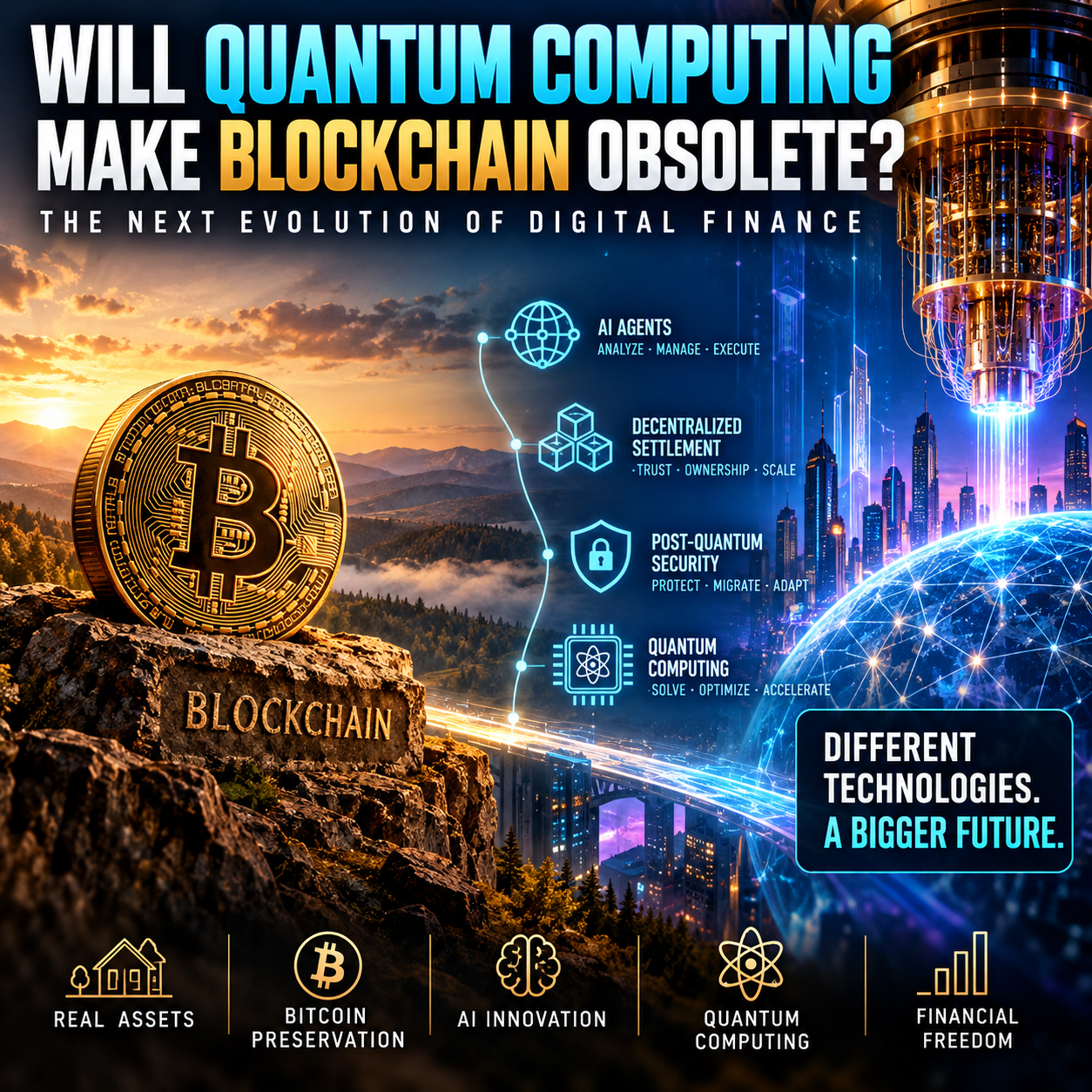
Bitcoin, artificial intelligence, quantum computing, and the race to build the financial infrastructure of tomorrow.
What if the greatest threat to blockchain isn’t another cryptocurrency, government regulation, or even a cyberattack? What if it’s an entirely new form of computing that could fundamentally change how digital ownership and financial networks operate?
For years, investors have debated which blockchain will dominate the future: Bitcoin, Ethereum, Solana, XRP Ledger, or an emerging competitor.
But perhaps we’re asking the wrong question.
Instead of asking which blockchain will win, we should be asking:
Will blockchain technology itself survive the quantum computing revolution?
And more importantly, where will the greatest investment opportunities emerge as these technologies converge?
Let’s explore.
The Quantum Computing Revolution
Traditional computers process information using bits, represented as zeros and ones.
Quantum computers use quantum bits, or qubits, which can exploit phenomena such as superposition and entanglement to perform certain types of calculations in fundamentally different ways.
This doesn’t mean quantum computers will automatically outperform traditional computers at everything.
Their advantage is expected to emerge in specialized areas, including molecular simulation, certain optimization problems, and cryptanalysis.
That last application is particularly important for cryptocurrency investors.
A sufficiently powerful, fault-tolerant quantum computer could potentially break the public-key cryptography protecting many of today’s blockchain networks.
Bitcoin, Ethereum, Solana, and numerous other networks rely on digital signature systems that could become vulnerable to sufficiently advanced quantum attacks.
But here’s the distinction many investors overlook:
Quantum computing threatens certain cryptographic foundations of blockchain. It does not automatically eliminate the need for blockchain itself.
Blockchain and Quantum Computing Solve Different Problems
Blockchain technology was designed to solve a fundamental problem: how can independent participants maintain a trustworthy record of transactions without relying on one central authority?
Quantum computing addresses something entirely different.
It introduces new computational capabilities.
One technology concerns trust, ownership, and consensus.
The other concerns computation.
A quantum computer might eventually perform calculations that classical computers cannot practically complete, but that doesn’t automatically establish who owns an asset, which transactions are valid, or how thousands of independent participants agree on a shared financial record.
Those problems still require rules, cryptographic verification, and trustworthy recordkeeping.
This leads to an interesting possibility.
Rather than replacing blockchain, quantum computing could help drive the development of an entirely new generation of decentralized financial infrastructure.
The Rise of Quantum-Resistant Blockchain
Some blockchain projects are already preparing for a post-quantum world.
However, not all quantum-security claims are equal.
A genuinely quantum-resistant blockchain must address far more than wallet signatures.
It must protect transaction authorization, validator authentication, consensus mechanisms, custody systems, and other critical infrastructure.
It must also provide a secure path for existing users to migrate away from vulnerable cryptography.
Several projects deserve attention.
NEAR Protocol: AI, Interoperability, and Quantum Security
NEAR is positioning itself at the intersection of artificial intelligence, cross-chain transactions, and decentralized financial infrastructure.
Its chain-abstraction strategy aims to make interaction across multiple blockchains easier for users and applications.
NEAR has also introduced support for post-quantum ML-DSA transaction signatures.
That’s meaningful progress.
But supporting quantum-resistant account signatures does not mean the entire network is quantum-resistant. Consensus and certain cross-chain signing mechanisms still require additional work.
NEAR’s investment thesis therefore extends beyond quantum security. Its long-term opportunity depends on whether AI agents, cross-chain transactions, and financial applications create sustainable economic activity.
Algorand: Building Quantum Security Into Financial Infrastructure
Algorand is another project worth watching.
Its support for Falcon-based post-quantum signatures offers an important foundation for protecting certain blockchain accounts.
For financial institutions considering long-term tokenized assets, cryptographic durability could become increasingly important.
However, Algorand still faces challenges in extending quantum resistance across its consensus infrastructure.
Its long-term success will depend on both technical execution and real-world adoption.
Quantum Resistant Ledger: Security From the Beginning
Quantum Resistant Ledger, or QRL, takes a different approach.
Rather than treating post-quantum cryptography primarily as a future upgrade, QRL was designed around hash-based digital signatures from its inception.
Its use of XMSS signatures provides a meaningful distinction from networks built around conventional elliptic-curve signatures.
But investors should recognize an important limitation.
Superior cryptography does not automatically create a superior investment.
A blockchain also needs users, developers, liquidity, economic activity, and a compelling reason for its native token to exist.
What About Bitcoin and Ethereum?
Bitcoin and Ethereum have significant network effects, established infrastructure, and active developer communities.
Both have pathways toward adopting post-quantum cryptography.
Ethereum has organized research and engineering efforts around post-quantum signatures, validator systems, and account security.
Bitcoin developers are examining possible migration approaches, including how to protect existing coins and introduce new signature mechanisms without compromising the network’s monetary properties.
Neither network should be considered fully quantum-resistant today.
Yet dismissing either simply because its migration is incomplete would overlook the considerable resources and incentives supporting its continued security.
The key question is whether these networks can transition before a cryptographically relevant quantum computer becomes a practical threat.
What If Blockchain Isn’t the Final Technology?
Now we arrive at the more fascinating possibility.
What if the next generation of financial infrastructure doesn’t look like today’s blockchain networks at all?
Researchers are already exploring quantum networks, quantum communication, distributed quantum computing, and hybrid systems combining classical and quantum technologies.
A future financial network could incorporate quantum-secured communications, post-quantum cryptographic signatures, decentralized ownership records, and AI-driven financial applications.
Imagine an infrastructure where autonomous AI agents can analyze investment opportunities, negotiate transactions, manage portfolios, and interact with financial institutions.
Meanwhile, distributed ledgers maintain verifiable ownership and settlement records.
Post-quantum cryptography protects digital identities and transaction authorization.
Specialized quantum processors handle computational tasks where they offer meaningful advantages.
These technologies could operate together rather than compete.
That is a much larger vision than simply launching another cryptocurrency.
Could a Quantum Internet Replace Blockchain?
A quantum internet is a legitimate area of scientific research.
Its purpose includes distributing quantum entanglement and connecting quantum devices.
But it isn’t automatically a replacement for today’s internet or public blockchains.
Quantum communication does not independently solve the economic and governance problems involved in decentralized consensus.
Likewise, quantum key distribution can help establish secure communication keys, but it does not by itself establish asset ownership or prevent double-spending.
A future quantum-native financial ledger is possible.
A commercially proven replacement for major public blockchains, however, has yet to emerge.
The Investment Opportunity Nobody Should Ignore
For investors, this technological transition presents a broader question.
What if the greatest opportunity isn’t choosing the winning cryptocurrency, but investing in the infrastructure that enables the transition?
Consider the industries involved.
1. Quantum Computing Hardware
Companies developing quantum processors, control systems, and error-correction technologies could benefit as quantum computing matures.
IBM, IonQ, and Rigetti are among the publicly traded companies investors can research.
But the industry remains technically challenging, and commercial success is far from guaranteed.
2. Post-Quantum Cybersecurity
Financial institutions, governments, corporations, and blockchain networks may need to replace vulnerable cryptographic systems.
That creates potential demand for security software, hardware security modules, identity infrastructure, and migration services.
Importantly, this opportunity extends far beyond cryptocurrency.
3. Quantum Networking and Communications
Specialized networking hardware, photonics, and secure communications infrastructure may become increasingly valuable as quantum systems develop.
Many of these technologies remain experimental or commercially immature.
4. AI and Computational Infrastructure
Quantum computing may eventually complement AI and classical high-performance computing.
Regardless of how quickly quantum technology advances, the demand for energy, data centers, networking equipment, and computational capacity represents a substantial infrastructure theme.
5. Quantum-Ready Digital Asset Networks
Projects such as NEAR, Algorand, and QRL offer different approaches to preparing digital assets for quantum threats.
But investors must evaluate their token economics and adoption independently of their technical achievements.
A project can survive the quantum transition without delivering attractive investment returns.
The Next Financial System May Be Hybrid
Consider how financial technology has evolved.
We moved from paper-based records to electronic banking.
From centralized databases to internet-based financial services.
From traditional payment networks to programmable blockchain infrastructure.
Now artificial intelligence is beginning to automate increasingly sophisticated financial activities.
Quantum computing could become another important layer in that evolution.
A plausible future architecture might include:
- AI agents handling analysis, underwriting, execution, and financial operations.
- Distributed ledgers maintaining verifiable records of ownership and settlement.
- Post-quantum cryptography securing transactions, identities, and financial infrastructure.
- Quantum processors performing specialized computational tasks.
- Interoperability networks connecting traditional institutions, digital assets, and emerging technologies.
Not every component requires its own blockchain.
Not every blockchain needs its own token.
And not every technological innovation will create value for public investors.
The winners will likely be the systems that deliver measurable economic utility while maintaining security, reliability, and cost efficiency.
What This Means for Bitcoin
Bitcoin remains particularly interesting because its investment thesis differs from that of most application-focused blockchains.
Bitcoin’s primary proposition is monetary scarcity, decentralized verification, and resistance to arbitrary changes in supply.
Quantum computing does not inherently invalidate those properties.
It does, however, create a serious long-term security challenge that Bitcoin’s ecosystem must address.
A successful post-quantum migration could preserve Bitcoin’s monetary characteristics while upgrading the cryptographic mechanisms protecting ownership.
But the transition must be approached carefully.
Bitcoin’s decentralized governance, legacy addresses, existing coins, and conservative development culture make coordination challenging.
That is why the most useful question isn’t whether Bitcoin is quantum-proof today.
It isn’t.
The better question is whether its ecosystem can deploy a secure migration before quantum attacks become practical.
No one can guarantee the answer.
But neither should investors assume that a future quantum breakthrough automatically makes Bitcoin worthless.
How REAL Is Thinking About the Future
At REAL—Real Estate Asset Ledger—our long-term vision is built around productive assets, recurring cash flow, Bitcoin accumulation, and modern financial infrastructure.
We believe durable wealth is created through ownership of productive assets, not simply speculation on the next technological trend.
That philosophy becomes even more important as technology evolves.
Rather than betting the entire future on one blockchain, our objective is to develop an adaptable infrastructure capable of integrating emerging financial technologies as they mature.
Bitcoin remains central to our proposed treasury strategy.
Tokenized real-world assets provide the foundation for connecting productive economic activity with digital ownership infrastructure.
Artificial intelligence offers opportunities to improve underwriting, asset management, and financial operations.
And post-quantum security must become an increasingly important consideration in the architecture of long-term digital wealth preservation.
The objective isn’t to predict every technological breakthrough.
It’s to build systems capable of adapting to them.
Own productive assets. Preserve capital. Embrace innovation. Build infrastructure designed to endure.
The Bigger Picture: From Speculation to Infrastructure Ownership
The cryptocurrency industry has spent years debating which token will outperform the others.
But the next decade could reward a different perspective.
Rather than focusing exclusively on price predictions, investors may benefit from examining the infrastructure that makes the next generation of finance possible.
Who provides the computing power?
Who owns the data centers?
Who supplies the energy?
Who secures the networks?
Who connects financial institutions with tokenized assets?
And which systems generate sustainable revenue from real economic activity?
These questions may ultimately prove more valuable than predicting which cryptocurrency experiences the next speculative rally.
Quantum computing could disrupt existing blockchain infrastructure.
It could also accelerate the development of more secure, interoperable, and capable financial networks.
The future may not belong exclusively to blockchain.
It may belong to the infrastructure connecting blockchain, quantum computing, artificial intelligence, and productive assets.
The next generation of wealth creation may come from owning the infrastructure that makes the future possible.
Join the Sovereign Builder Network
The future of finance is being built now.
At the Sovereign Builder Network, we’re exploring how entrepreneurs, investors, and capital stewards can participate in the evolution of ownership, capital formation, Bitcoin, artificial intelligence, and productive assets.
Our mission is to connect forward-thinking builders with the knowledge, relationships, and opportunities needed to navigate the emerging financial economy.
Join us for our Thursday Night Sovereign Builder Masterclass, where we explore the strategies, technologies, and financial frameworks shaping the future of wealth creation.
And if you haven’t already, download your free copy of Equity Alchemy to discover how capital structure, leverage, and productive-asset ownership can work together.
Build Wealth. Build Assets. Build Systems.
Welcome to the Sovereign Builder Network.
Disclaimer: This article is for educational and informational purposes only and does not constitute investment advice or an offer to buy or sell securities or digital assets. Quantum computing timelines, cryptographic migration efforts, and emerging technology adoption remain uncertain. Readers should conduct independent research and consult qualified professionals before making investment decisions.