
Artificial intelligence is rapidly becoming one of the most important technological shifts of our lifetime.
But investors may be looking at the wrong part of the opportunity.
The obvious trade is to find the next great AI model, application or token. The deeper opportunity may be owning the infrastructure that all of them need to operate.
Think about what an autonomous digital economy actually requires.
AI needs compute.
Compute needs GPUs.
GPUs need power, cooling, fiber and data centers.
AI agents need data.
Digital applications need blockchains capable of executing transactions.
Those blockchains need interoperability.
Capital needs lending markets.
Assets need collateral.
And ultimately, the entire system needs reliable monetary infrastructure.
Once you look at decentralized AI through this lens, individual projects begin to look less like competitors and more like pieces of an emerging technology stack.
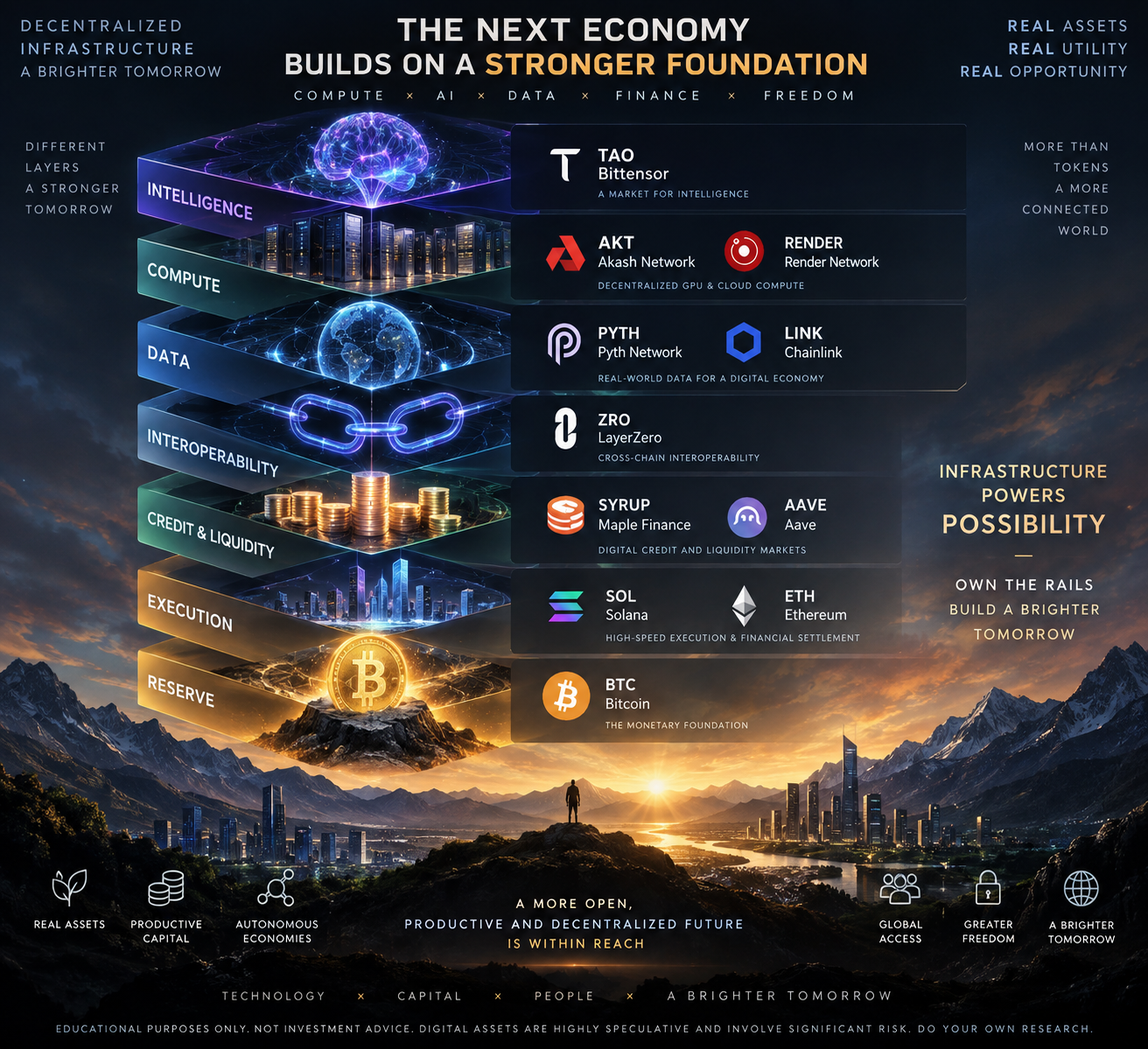
The Decentralized AI Stack
The future could look something like this:
Energy → Compute → Intelligence → Data → Execution → Interoperability → Credit → Liquidity → Settlement
Different decentralized networks are already attacking each layer.
And several projects stand out because of how naturally they can interact with one another.
1. Compute: Akash Network
Before decentralized AI can exist at scale, somebody has to provide the computing power.
Akash Network is building a decentralized cloud marketplace where infrastructure providers can make computing resources available to users who need them.
That creates an interesting economic bridge between the physical and digital worlds.
A data-center operator could own GPUs, power infrastructure and networking equipment while distributing available capacity through decentralized compute marketplaces.
Instead of merely owning hardware, the infrastructure becomes a productive digital asset capable of generating revenue.
2. Intelligence: Bittensor
This is where things get considerably more interesting.
Bittensor isn’t simply trying to decentralize GPU capacity. It is attempting to create markets for machine intelligence itself.
Its subnet architecture allows specialized markets to emerge around different forms of AI output, models, data and computational services.
Think about the relationship:
Akash can help create a market for compute.
Bittensor can help create a market for intelligence produced with compute.
That distinction matters.
Compute is the raw resource.
Intelligence is the finished product.
If decentralized AI becomes a major economic system, owning exposure to both layers could prove far more powerful than trying to predict which individual AI application ultimately wins.
3. Data: Pyth and Chainlink
Artificial intelligence is only as useful as the information available to it.
This becomes especially important when AI agents begin making financial decisions autonomously.
An agent trading assets, underwriting credit, managing collateral or allocating capital needs reliable external information.
That is where oracle infrastructure becomes critical.
Networks such as Pyth and Chainlink provide mechanisms for bringing external information into blockchain environments.
The AI might provide the intelligence.
The blockchain provides execution.
But the oracle tells the system what is actually happening outside the blockchain.
That makes decentralized data infrastructure another potential picks-and-shovels investment in the AI economy.
4. Execution: Solana and Ethereum
Once autonomous agents begin performing economic activity, they need somewhere to transact.
This is where blockchain networks such as Solana and Ethereum become increasingly important.
Solana’s high-throughput architecture makes it particularly interesting for applications involving large numbers of inexpensive transactions.
Ethereum, meanwhile, has developed into one of the dominant settlement environments for decentralized finance, stablecoins, tokenized assets and blockchain-based financial infrastructure.
Rather than assuming one network eliminates the other, the more interesting possibility is a multichain economy where different networks specialize.
AI agents may eventually move between these environments depending upon what they are trying to accomplish.
And that creates another problem.
They need to communicate.
5. Interoperability: Chainlink and LayerZero
A fragmented blockchain economy cannot become a truly global digital economy unless information and assets can move between networks.
That is why interoperability infrastructure matters.
Projects such as LayerZero and Chainlink CCIP are approaching different pieces of this problem.
Imagine an autonomous agent operating across multiple blockchain environments.
It might receive data from one network, hold collateral on another, borrow from another protocol and settle a transaction somewhere else entirely.
The user shouldn’t necessarily have to understand any of that complexity.
The infrastructure underneath the application should handle it.
This is analogous to the internet.
Most people don’t understand the networking protocols involved when they open a website.
They simply expect the internet to work.
Blockchain infrastructure will eventually need to reach the same level of abstraction.
6. Digital Credit: Maple
Then we arrive at one of the most important components of any functioning economy:
Credit.
Capital needs somewhere to flow.
Businesses borrow.
Investors lend.
Assets become collateral.
Productive activity generates yield.
Protocols such as Maple Finance are helping build institutional credit markets on-chain.
This could become increasingly important as traditional financial assets migrate onto digital rails.
Instead of decentralized finance being primarily about speculative leverage, blockchain credit markets could increasingly finance productive economic activity.
That is a substantially larger opportunity.
7. Liquidity: Aave
Aave represents another piece of the capital layer.
Its decentralized lending markets allow digital assets to become productive collateral rather than simply sitting dormant.
That concept becomes especially powerful when combined with tokenized real-world assets.
Imagine eventually owning tokenized exposure to:
real estate,
energy infrastructure,
AI data centers,
businesses,
equipment,
farmland,
or other productive assets.
Those assets could potentially participate in blockchain-based capital markets where collateral, lending and liquidity operate continuously.
The distinction between traditional finance and decentralized finance begins disappearing.
There is simply digital capital.
8. Bitcoin: The Reserve Layer
Underneath all of this sits another interesting possibility.
Bitcoin doesn’t necessarily need to become the blockchain executing every AI transaction.
Its larger role could be monetary.
Bitcoin can function as a scarce digital reserve asset while faster networks, credit protocols, AI systems and applications operate above it.
That creates a potential hierarchy:
Bitcoin = reserve asset
Ethereum/Solana = settlement and execution
Chainlink/Pyth/LayerZero = data and interoperability
Aave/Maple = liquidity and credit
Akash = compute
Bittensor = intelligence
And suddenly something becomes apparent.
These aren’t necessarily isolated investments.
They are components of an emerging decentralized economic operating system.
The REAL Opportunity
And here is where I believe the biggest opportunity may ultimately exist.
What happens when someone puts all of these pieces together?
Imagine a platform that doesn’t merely invest in decentralized infrastructure.
It owns and operates portions of it.
It could own physical infrastructure such as:
land + power + fiber + data centers + GPUs.
It could supply compute into decentralized networks.
It could participate in decentralized intelligence markets.
It could operate validators, nodes or specialized AI infrastructure.
It could hold strategic positions in the protocols it actively uses.
It could participate in digital credit markets.
It could tokenize productive real-world assets.
It could allow those assets to become collateral.
And it could maintain Bitcoin as part of its long-term reserve architecture.
Now the model becomes:
Own the infrastructure.
Provide the compute.
Earn from the networks.
Accumulate the assets.
Provide the intelligence.
Finance productive assets.
Collect the fees.
Recycle the capital.
That is the real opportunity — no pun intended.
The biggest winner in decentralized AI may not ultimately be one AI token, one blockchain or even one model.
It could be the infrastructure layer connecting physical assets, decentralized compute, artificial intelligence and digital capital into one productive economic system.
A project built around that thesis will eventually exist.
For now, we’ll leave it at that.
Follow the Build
We are watching the convergence of Bitcoin, AI, decentralized infrastructure, tokenization and digital capital happen in real time.
My focus isn’t simply finding the next token.
It’s understanding — and ultimately building around — the infrastructure that could power the next generation of the digital economy.
If you’re an investor, operator, builder or simply someone trying to understand where this is heading, follow along.
I’ll continue breaking down the protocols, infrastructure, investment opportunities and economic models shaping this transition.
Follow. Subscribe. Share this with another builder.
The next economy isn’t going to build itself.
Let’s build it.
